What’s emerging

Antidote to the Anthropocene: Empowering Local Governments

The most underrated instrument for life after the Anthropocene isn’t a new technology — it’s the local government already shaping how most of us live.

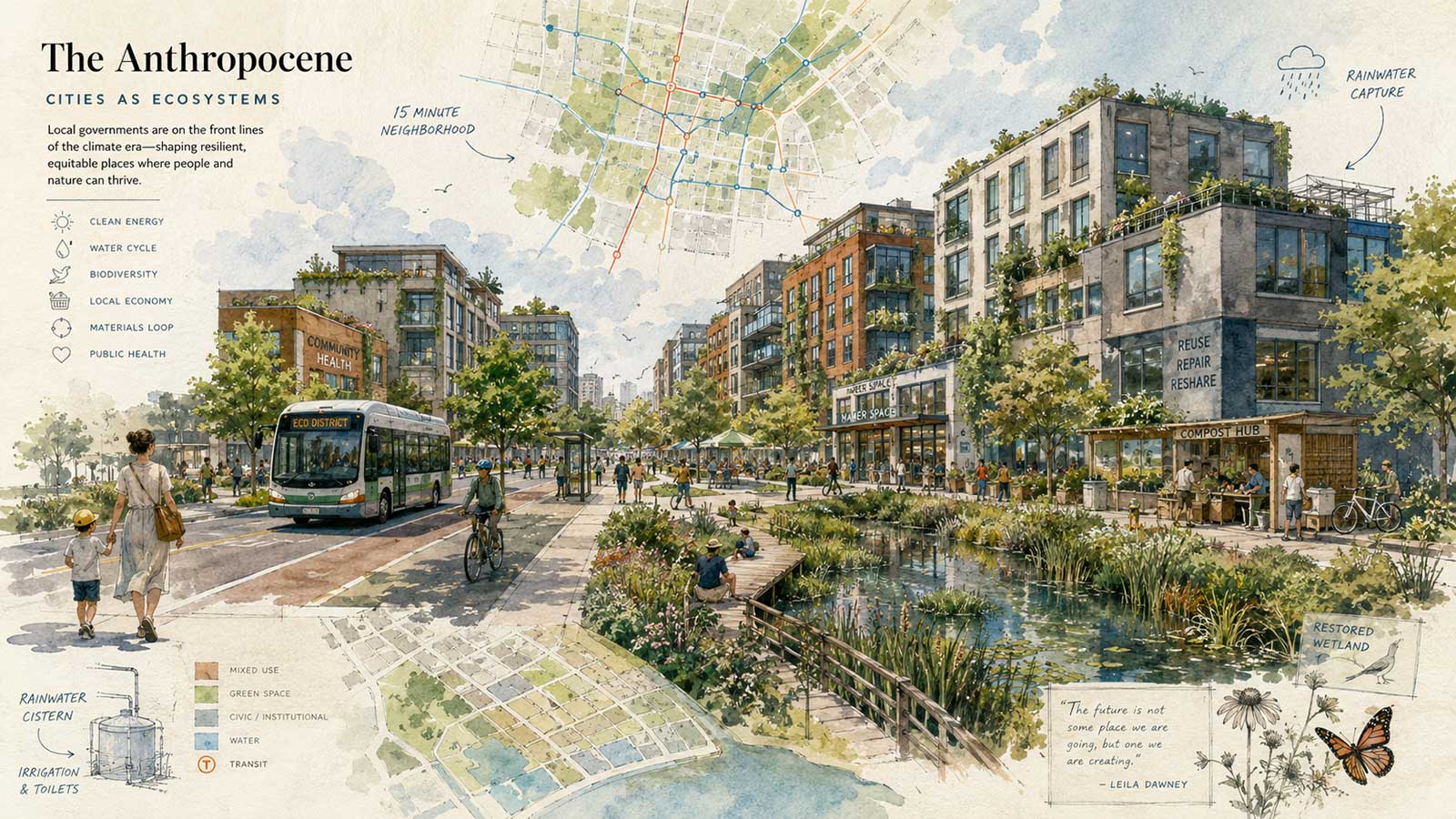
Watercolor illustration titled “The Anthropocene: Cities as Ecosystems,” showing a green, walkable neighborhood with transit, rooftop solar, rainwater capture, a restored wetland, a compost hub and a reuse-and-repair space.

We tend to picture the antidote to the Anthropocene as something dramatic and far away — a breakthrough technology, a treaty, a movement. Heather Benoit’s argument is quieter and more uncomfortable: the lever is already in our hands, sitting in city halls and zoning offices, shaping the everyday choices that got us here in the first place.

Welcome to the Anthropocene

The Anthropocene names a simple, sweeping fact — humanity has left a permanent fingerprint on the planet. Geologists mark its start with radioactive traces settled into soil after the first atomic detonations, but the lived reality is far blunter than a line in the sediment. We have moved mountains, dammed and drained rivers, triggered earthquakes drilling for fuel, acidified oceans, and thinned the atmosphere.

What makes the essay land is where it locates the cause. Not in a distant villain — not capitalism alone, not national governments alone, not someone else’s carelessness — but in the ordinary texture of how we live. If our way of life is the root of the problem, then changing the problem means changing the way of life. And that is far harder than inventing a new machine.
Why local government

Behavior, Benoit notes, is mostly a product of environment. We act the way the places around us let us act — the infrastructure, physical and social, that quietly dictates how we learn, work, move and live. Those environments are largely set at the local level. With roughly four in five Americans living under the jurisdiction of a local government, cities and counties become the most consequential — and most overlooked — actors in any serious transition.

Yet the way we plan cities still optimizes almost entirely for present-day human comfort: observe today’s conditions, prioritize immediate convenience, clear away whatever stands in the path. The result is a sophisticated human habitat — a microcosm tuned for people and walled off from the living systems around it. Imagine, Benoit asks, if nature were “planned” the way we plan our blocks. We’d find it absurd. We just don’t notice when we do it to ourselves.

We design cities as habitats for humans. The future asks us to design them as ecosystems.

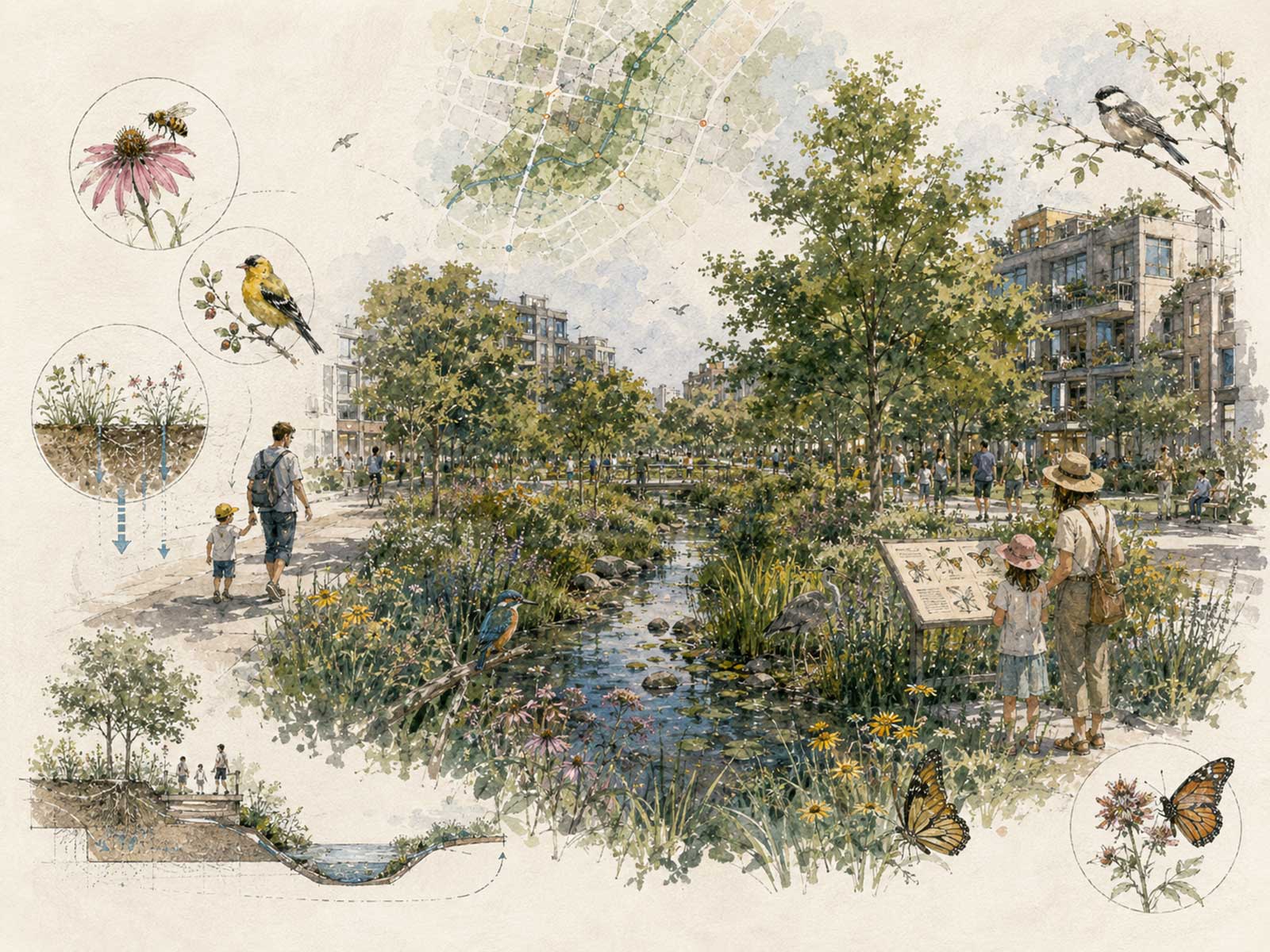
Watercolor of a revived city street where a daylit stream, rain gardens and street trees thread between mid-rise buildings, with songbirds, butterflies and a soil-infiltration cross-section labeled around the edges.
Habitat becomes ecosystem — a street designed for people and the living systems around them.

A paradigm of symbiosis

The proposed shift is from habitat to ecosystem — a more holistic frame in which a city is judged by the health of the relationships running through it, not merely the comfort of one species. Benoit calls this a paradigm of symbiosis: a relationship in which each participant, human and non-human, built and natural, contributes to the others’ wellbeing. Re-centering governance on that idea means rewriting design and policy so that mutual benefit, rather than dominion, becomes the default. In practice she draws out three moves:

  • LandHolistic land useShift land-use practice from dominion over a site to integration with it.
  • ResourcesResource loop closureWrite policy so the flow of resources stays inside ecological balance rather than running one-way to waste.
  • VoicePost-anthropocentric representationBuild decision-making frameworks that give every environmental stakeholder — not only humans — a seat at the table.
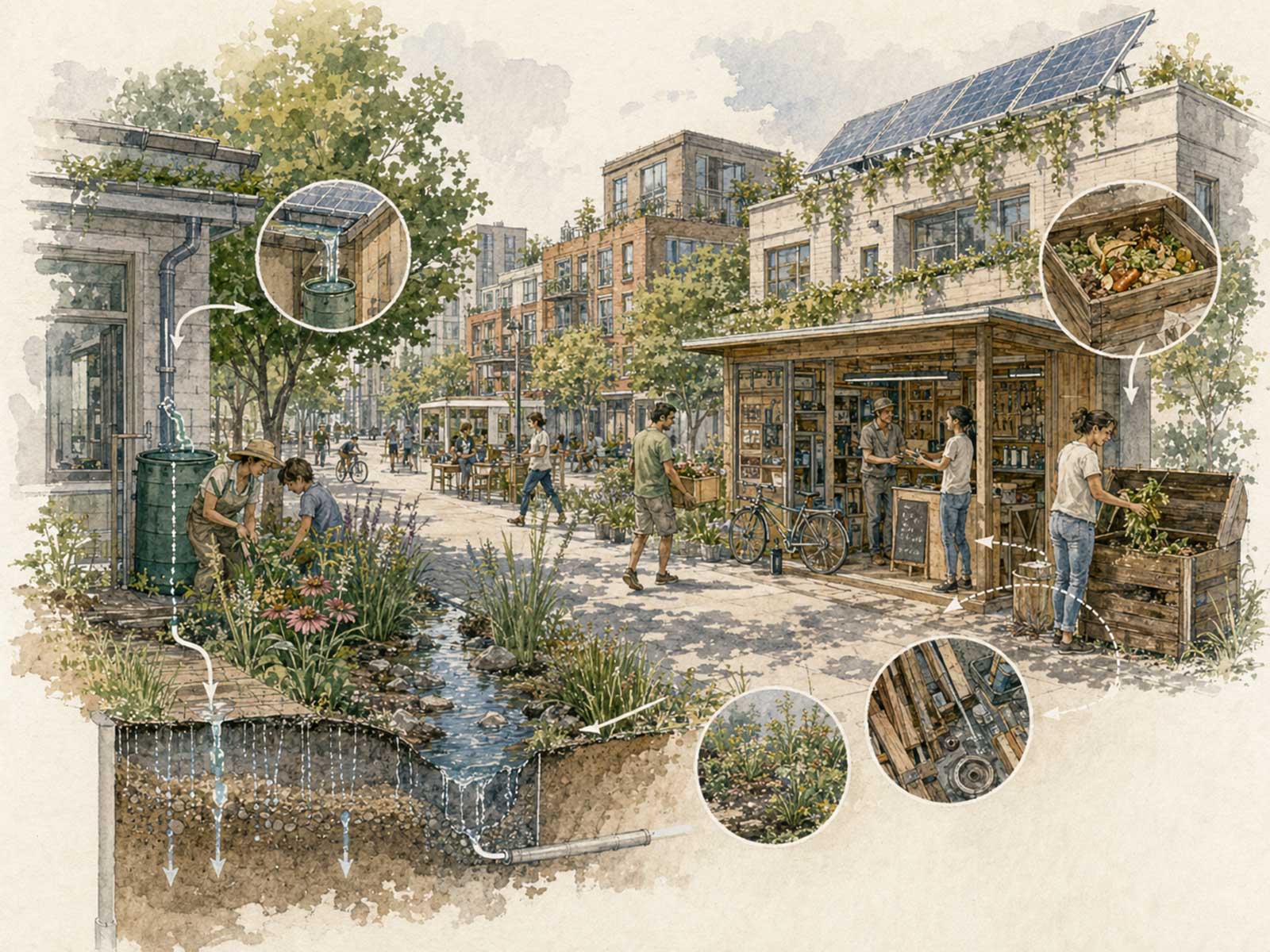
Watercolor of a neighborhood closing its resource loops — rooftop solar, rainwater barrels feeding a rain garden, a tool-and-repair shop and community composting — with detail callouts showing water, materials and reuse.
Resource loops, closed at the block scale: water, materials and repair kept in ecological balance.

From imagination to implementation

Bold ideas are easy to admire and easy to shelve. The sharpest move in the essay is its refusal to stop at the vision. Too often, Benoit argues, foresight stalls the moment the final report is delivered — something is lost in translation between insight and action, and clients are left holding options when what they needed was a path. If the purpose of foresight is to usher in better futures, then implementation matters every bit as much as imagination.

So the speculative gets translated back into instruments municipalities already hold: holistic land use becomes zoning, resource loop closure becomes utilities, post-anthropocentric representation becomes community engagement. A “mild-to-wild” spectrum then steps each policy from modest to radical, pairing every increment with real projects already underway — so a leader can see not just the destination but the next move. In the end, it’s the getting there that counts most.

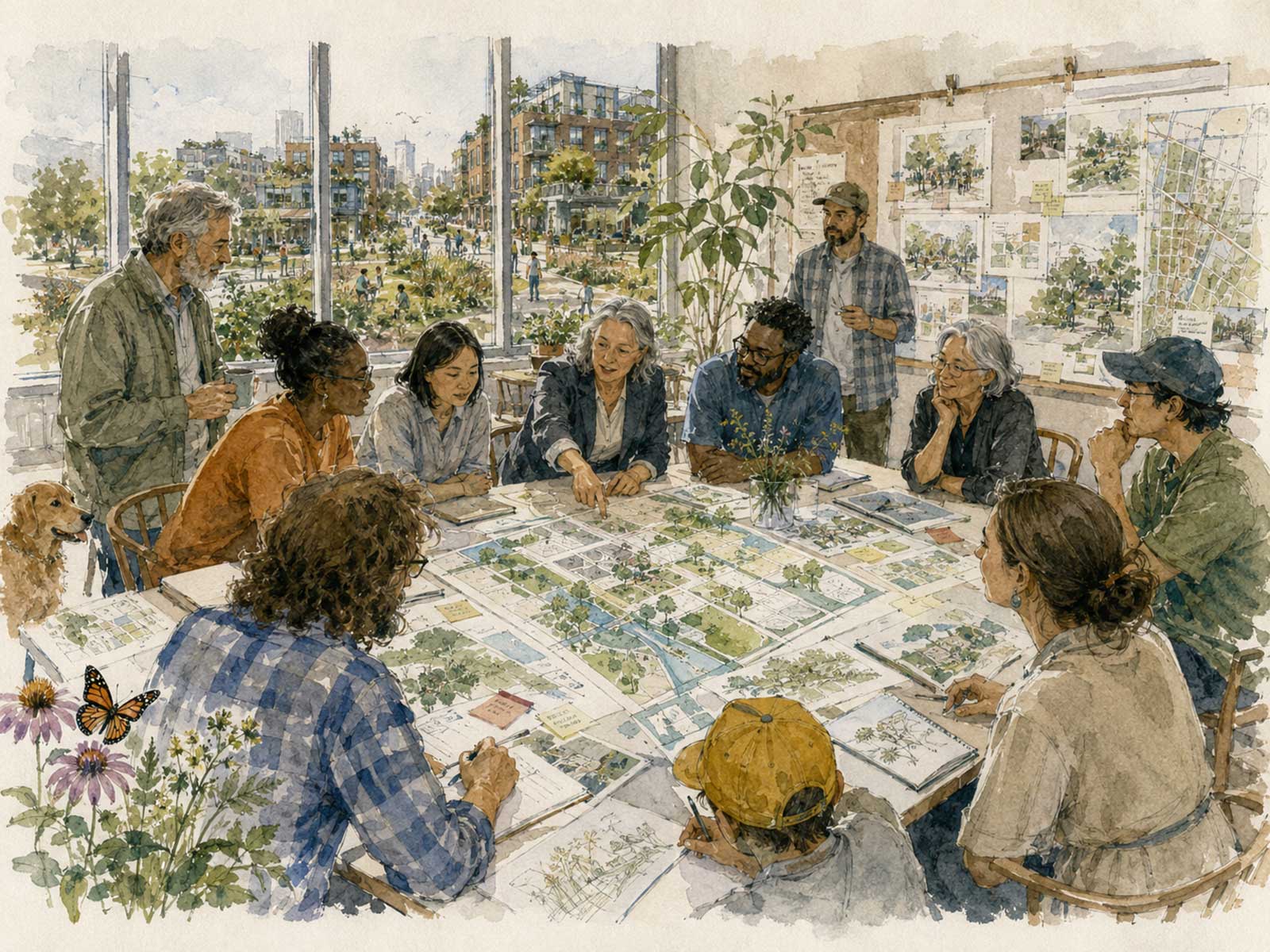
Watercolor of a diverse group gathered around a table covered in neighborhood maps and plans, with a green, revived city visible through the windows behind them.
Post-anthropocentric representation in practice — community engagement that brings every stakeholder to the table.

“Antidote to the Anthropocene: Empowering Local Governments,” by Heather Benoit, first appeared on Houston Foresight. Read it in the original ↗

More signals

The next hard question is coming.

Let’s make sure you have somewhere to take it.

Start a conversation