Disease pattern volatility
Health systems were built for diseases that behaved predictably — known ages, known places, known trajectories. That predictability is breaking down, and planning for a moving target is a different discipline entirely.
Change driver · Updated July 2026
The shift ahead
From predictable patterns to moving targets
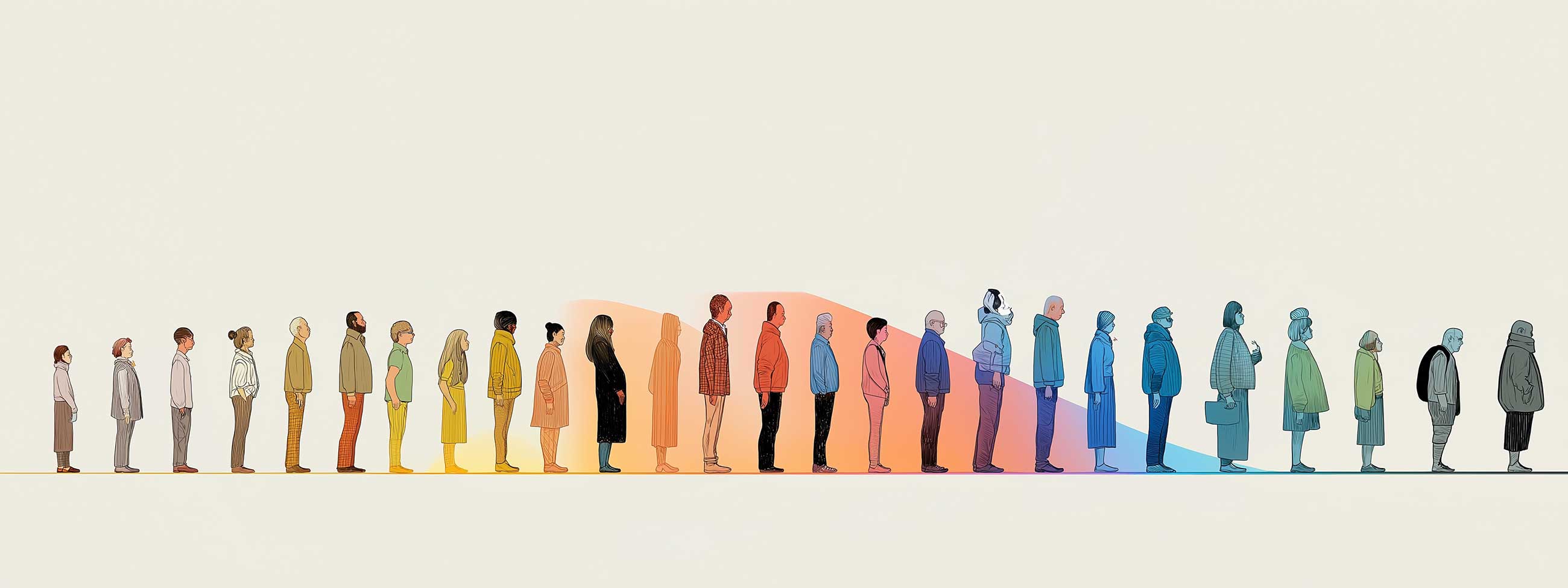
For a long time, disease came with defaults — who got it, when and where. The change is that those defaults are slipping, and the patterns systems were built to expect keep moving.
A cancer long treated as an older person’s disease starts appearing in people in their forties. A tropical illness turns up in temperate cities that never planned for it. A new class of drug rewrites who counts as sick in the first place. The map of what to expect, and where, is being redrawn faster than the systems built on it can revise.
The shift is not a wave of brand-new diseases. It is the movement of disease itself into less predictable behavior — pushed by climate, biology, behavior and treatment interacting in ways that defeat the old assumptions about age, geography and trajectory.
Why it matters
You cannot plan capacity, screening or prevention around a pattern that will not hold still.
Almost everything health systems do assumes a predictable backdrop: who to screen and at what age, where to stock what, which threats to prepare for. When the backdrop moves, those assumptions quietly expire — screening ages set for the wrong decade, defenses built for the wrong geography, plans anchored to a baseline that no longer exists.
So the useful capability shifts from knowing the pattern to sensing the change in it. The advantage goes to systems that can detect a shift early, hold assumptions loosely and adapt faster than the disease landscape moves. The ones that treat last decade’s pattern as permanent are planning, in detail, for a world that is already gone.
Possible futures this could enable
-
01
Who gets sick, and when, stops being fixed
Long-standing assumptions about the age a disease belongs to break down, forcing the rules built on them to be rewritten.
Early signalColorectal cancer, long treated as an older person’s disease, is rising sharply in adults under 50 for reasons still unknown, which pushed the US to lower the recommended screening age from 50 to 45.
-
02
Where a disease lives stops being fixed
Illnesses migrate into places that never had to plan for them, as the conditions that once contained them shift.
Early signal2024 was the worst dengue year on record — about 14 million cases worldwide — and the warming that drives it is pushing the mosquito into new ground, with US cases jumping 359% in 2024.
-
03
What counts as a disease keeps moving
A treatment breakthrough can redraw the boundaries of a condition — who has it, how it progresses and what it sits next to.
Early signalGLP-1 drugs made for diabetes now win approval for one condition after another — heart disease, sleep apnea, kidney and liver disease — and a 2025 study linked them to lower risk across 42 conditions, redrawing what a single drug class treats, though many must keep taking them to hold the results.
Right now, disease is moving faster than the assumptions built around it.
You can see it in falling screening ages, in tropical illnesses appearing in temperate places, in drugs that redraw whole categories of condition. Some systems are already building for a moving target — flexible capacity, faster surveillance, assumptions they revisit on purpose. Others are still running on baselines set a generation ago.
The line that matters is the line between planning for the pattern and planning for the change in it. The stronger version builds in the expectation that the ground will move, and stays ready to revise. The weaker version mistakes a long-standing pattern for a permanent one, and gets caught planning precisely for the wrong world.
Watch which assumptions a system treats as permanent.
The driver strengthens as age, geography and predictability stop being reliable anchors — as younger patients, new regions and treatment-driven shifts break the defaults that screening, capacity and prevention were built on. It strengthens each time a settled expectation about a disease turns out to have an expiry date.
The question is not whether the old patterns were once right. They were. The question is whether a system can notice when a pattern stops being true, and change course before the gap between plan and reality does the damage.
This is one force among many.
We track the ones that will reshape your field, and what to do about them.