Future Artifacts

Signals from the edge

When your body gets a second copy

Published July 2, 2026

A medical digital twin is a patient-specific computational model that can simulate some aspect of a person’s biology, disease or treatment response. Today, that idea exists in narrow but increasingly serious forms: coronary models derived from CT scans, statistical twins used to make clinical trials more efficient, retrospective oncology models and diabetes simulations that help tune automated insulin delivery. None of this is the same as a whole-patient twin that lives inside your chart and updates as you do. But the pieces are no longer only speculative. The foresight question is what has to be true before a continuously updating model of you becomes part of how care actually gets decided.

A cleared, paid-for coronary model has crossed real adoption thresholds

HeartFlow turns coronary CT data into patient-specific 3D models and analyses of coronary anatomy, blood flow and plaque. Its tools are FDA-cleared, payer coverage has expanded through national insurers including UnitedHealthcare and Cigna for eligible uses, and the company reports use in care for more than 500,000 patients worldwide.1 This is a real signal that a narrow, well-defined computational model can clear regulatory, reimbursement and adoption hurdles. It is not proof that a broader, whole-patient twin is close behind.

Abstract visualization of coronary artery blood flow
Image · cardiac digital twin

Regulators have qualified a digital-twin-based trial method

Unlearn.AI’s PROCOVA method uses prognostic scores derived from participants’ digital twins to improve the efficiency of Phase 2 and 3 trials with continuous outcomes. The European Medicines Agency issued a formal qualification opinion for the methodology, and FDA later stated that it concurred with EMA that PROCOVA does not deviate from current guidance.2 The January 2026 FDA/EMA AI principles add another signal of regulatory alignment, but they are guiding principles, not binding regulation.

Clinical trial setting representing synthetic control arm research
Image · clinical trial twin

An oncology twin has shown retrospective treatment-response signal

FarrSight®-Twin recreated eight historical Phase II/III trials in breast, pancreatic and ovarian cancer with a digital twin for every participant. Patients who received the treatment the model predicted as better had a 75% response rate, versus 53.5% for patients whose treatment did not match the prediction.3 That is a striking retrospective signal — not proof that the tool is ready to guide live oncology treatment decisions.4

Abstract visualization representing an oncology digital twin
Image · oncology digital twin

A diabetes twin has supported real-time therapy optimization

In a randomized Type 1 diabetes trial, digital-twin replay simulation supported biweekly optimization of automated insulin delivery, improving time-in-range from 72% to 77% and lowering HbA1c from 6.8% to 6.6%.5 Small and narrow — but unlike the retrospective oncology example, this twin helped adjust what happened next.

Continuous glucose monitor representing chronic disease digital twin dosing
Image · glucose twin dosing

Signal vs. noise

The signal is not that every predictive model has become a digital twin. The signal is that several patient-specific computational models are crossing different thresholds: regulatory clearance, payer coverage, trial qualification, retrospective validation and live therapy optimization. These claims sound similar but deserve different levels of trust.

Signal

Regulatory qualification is a higher bar than model performance

The stronger signal is not simply that a model performs well. It is that a regulator has agreed a specific method can be used in a defined development context. PROCOVA’s EMA qualification is one such threshold; the FDA/EMA AI principles are another sign of regulatory alignment, though they are not binding rules. Existing SaMD pathways still were not built for adaptive, self-updating patient models.26

Signal

Retrospective validation is a legitimate first step

FarrSight-Twin proved itself against real historical trial data before anyone asked it to guide a live decision. That ordering — retrospective replay, then prospective use — is exactly the sequence oncology twins are still working through.34

Signal

Continuous updating is what separates a twin from a one-time model

A one-time risk score is not a digital twin wearing a new name. Across the research, the stronger definition points to a patient-specific model that can be updated as new information arrives — imaging, labs, symptoms, treatments and clinical events.7

Noise

“Digital twin” is becoming a label for too many things

The same term is being used for imaging-derived models, prognostic trial methods, retrospective oncology simulations and chronic-disease optimization tools. That does not make the term useless. It means every claim has to state the maturity level, use case and clinical decision it actually supports.

Noise

“Digital twins will replace clinical trials”

The research is explicit that twins are being used as trial accelerants — smaller control arms, faster interim reads — not replacements for randomized evidence. Complement, not substitute.2

Noise

“A twin removes the need for a clinician in the loop”

In a 13,806-patient multinational survey, 72.9% of patients preferred physician-led decisions even when the AI was viewed as accurate.8 Every credible framework here calls for human oversight scaled to risk, not autonomy.

What would make this real

As of July 2026

Medical digital twins already exist in partial, narrow forms. The question is what would have to change before a leader should treat a continuously updating patient model as part of standard care.

WatchpointWhat would change the decisionCurrent status
Prospective clinical validationA patient-specific computational model shows peer-reviewed outcome improvement in a live care pathway, not only a retrospective replay of trials that already happened.EmergingShown in narrow areas such as automated insulin delivery; still immature in oncology.
Regulatory qualification at scaleMore than one patient-specific modeling methodology receives formal regulatory qualification for a defined clinical development or care use case.6EarlyPROCOVA is an early qualified trial-method example; scope remains narrow.
Continuous-update infrastructureA health system operationally keeps a twin current across imaging, labs and visits — not a point-in-time snapshot relabeled as a twin.7Not yetProposed in research; not built at operational scale.
VVUQ as a credentialing requirementA risk-based verification, validation and uncertainty framework becomes something twins are required to pass, not an academic proposal.9EarlyFrameworks proposed; not yet a standard.
Dynamic consent in practiceA health system implements revisable, opt-in/opt-out consent suited to a model that keeps changing, replacing one-time broad consent.1011Not yetCalled for; no established operational model.
Oncology moves past replayAn oncology twin like FarrSight-Twin guides one real, prospective treatment-selection decision, not a retrospective trial recreation.34Not yetThe decisive oncology threshold.

How to build readiness

1Treat this as a data problem before a model problem

A twin is only as current as the data feeding it. Organizations whose imaging, labs and clinical records don’t already talk to each other aren’t six months from a digital twin — they’re years from the interoperability a twin assumes.

2Pilot in decision support, not autonomous decision-making

Start where a clinician reviews the model’s output and can override it. HeartFlow is used alongside clinical judgment, and FarrSight-Twin remains a retrospective oncology signal rather than a live autonomous treatment selector. Unsupervised use is where credible governance frameworks draw the line.

3Keep the value streams separate

Most disappointment will come from treating different maturity levels as one promise. Judge each value stream on its own evidence:

  • Trial-efficiency valueDoes it reduce sample size or control-arm burden?
  • Retrospective-validation valueDoes it accurately replay outcomes that already happened?
  • Prospective-clinical valueDoes it improve a real, live treatment decision?
  • Patient-trust valueDoes it stay explainable and clinician-led enough for patients to accept it?
  • Regulatory-credibility valueHas it cleared, qualified or aligned with a defined regulatory pathway for its specific use?

4Build consent and governance before scale

A model that keeps updating breaks one-time, broad-consent thinking. Dynamic consent, data ownership and explainability requirements are the unglamorous infrastructure that decides whether any of this is trusted at all.

The futurist’s take

It’s not one technology yet.
It’s three, wearing the same name.

A “digital twin” can mean an FDA-cleared coronary analysis tool, a regulator-qualified statistical method in trial design, a retrospective oncology simulation or a diabetes model used to tune automated insulin delivery. Those are different maturity levels wearing the same name. Most of the disappointment ahead will come from treating them as one.

The organizations that take this seriously will not chase the most futuristic-sounding pilot. They will name, precisely, which maturity level they are buying, which decision it can support and which safeguards it needs before patients are asked to trust it.

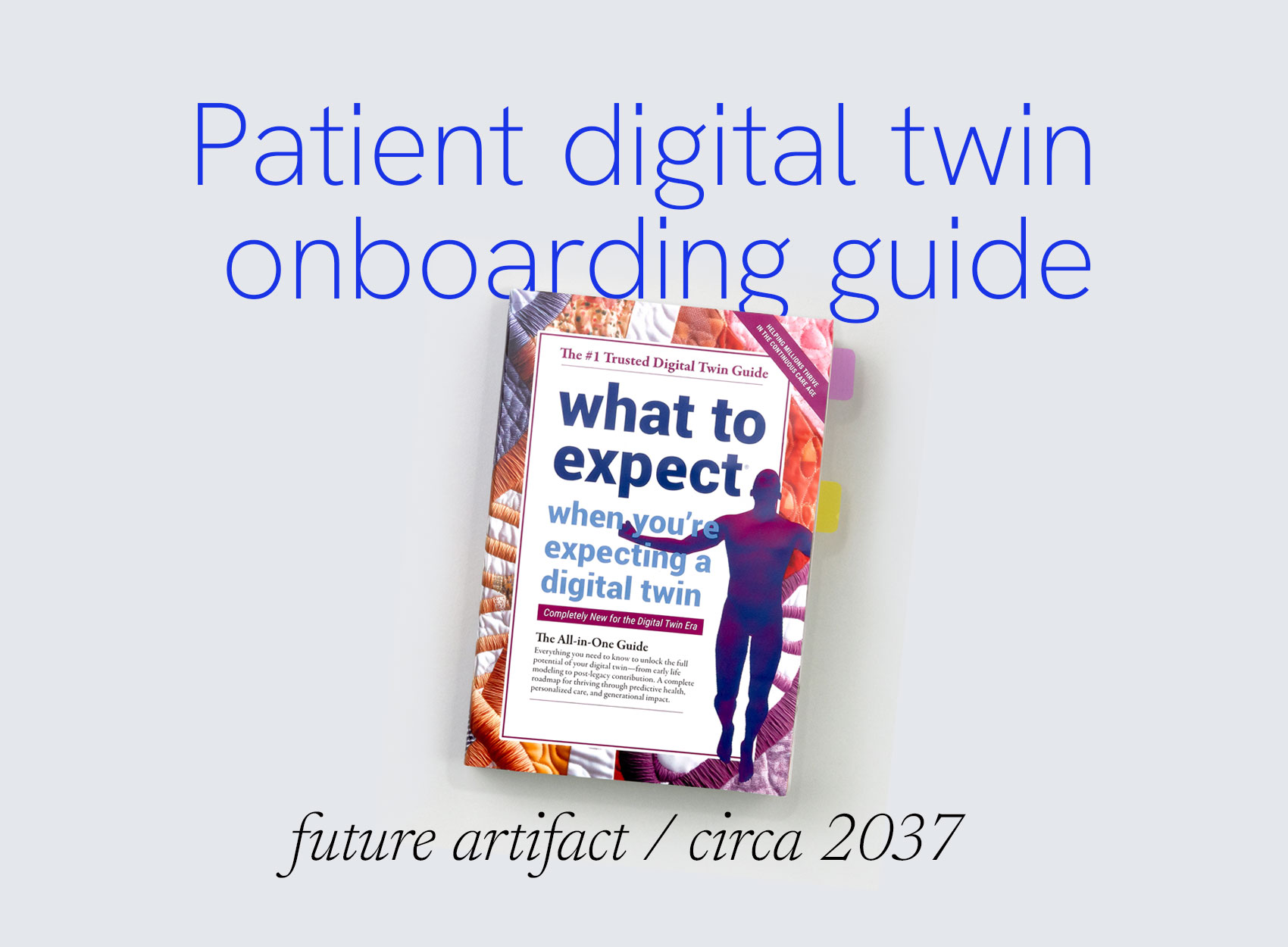
From evidence to artifact

See how we used disciplined imagination to turn weak signals into a tangible artifact from the future.

References

  1. Sarani Rad et al. (2026). Technologies, Clinical Applications, and Implementation Barriers of Digital Twins in Precision Cardiology: Systematic Review. doi:10.2196/78499
  2. Bertolini et al. (2026). Digital Twins as Synthetic Controls in Single-Arm Trials. arxiv.org/abs/2605.12832
  3. Karaman and Sebin (2025). From data-driven cities to data-driven tumors: dynamic digital twins for adaptive oncology. doi:10.3389/frai.2025.1624877
  4. Ștefănigă et al. (2024). Advancing Precision Oncology with Digital and Virtual Twins: A Scoping Review. doi:10.3390/cancers16223817
  5. Kovatchev et al. (2025). Human-machine co-adaptation to automated insulin delivery: a randomised clinical trial using digital twin technology. doi:10.1038/s41746-025-01679-y
  6. Lal et al. (2022). Regulatory oversight and ethical concerns surrounding software as medical device (SaMD) and digital twin technology in healthcare. doi:10.21037/atm-22-4203
  7. Tudor et al. (2025). A scoping review of human digital twins in healthcare applications and usage patterns. doi:10.1038/s41746-025-01910-w
  8. Busch et al. (2025). Multinational Attitudes Toward AI in Health Care and Diagnostics Among Hospital Patients. doi:10.1001/jamanetworkopen.2025.14452
  9. Sel et al. (2025). Survey and perspective on verification, validation, and uncertainty quantification of digital twins for precision medicine. doi:10.1038/s41746-025-01447-y
  10. Tigard (2021). Digital twins running amok? Open questions for the ethics of an emerging medical technology. doi:10.1136/medethics-2021-107526
  11. März et al. (2025). Digital twins for children with rare diseases: an exploration of the legal and ethical issues. doi:10.1007/s10676-025-09848-z
Additional references
  1. Zou et al. (2025). Digital twins in cardiovascular disease: a scoping review. doi:10.1016/j.ijmedinf.2025.106138
  2. Shen et al. (2025). From virtual to reality: innovative practices of digital twins in tumor therapy. doi:10.1186/s12967-025-06371-z
  3. Sel et al. (2024). Building Digital Twins for Cardiovascular Health: From Principles to Clinical Impact. doi:10.1161/jaha.123.031981
  4. Pothireddy (2025). GenAI-Powered Digital Twins for Chronic Disease Management. doi:10.36948/ijfmr.2025.v07i02.40878
  5. Zarei et al. (2026). Application of Digital Twin Technology to Enhance Chronic Diseases Management: A Systematic Review. doi:10.1155/ijta/2299762
  6. Wang et al. (2024). TWIN-GPT: Digital Twins for Clinical Trials via Large Language Model. doi:10.1145/3674838
  7. Das, Wang and Sun (2023). TWIN: Personalized Clinical Trial Digital Twin Generation. doi:10.1145/3580305.3599534
  8. Sadée et al. (2025). Medical digital twins: enabling precision medicine and medical artificial intelligence. doi:10.1016/j.landig.2025.02.004

The next hard question is coming.

Let’s make sure you have somewhere to take it.

Start a conversation