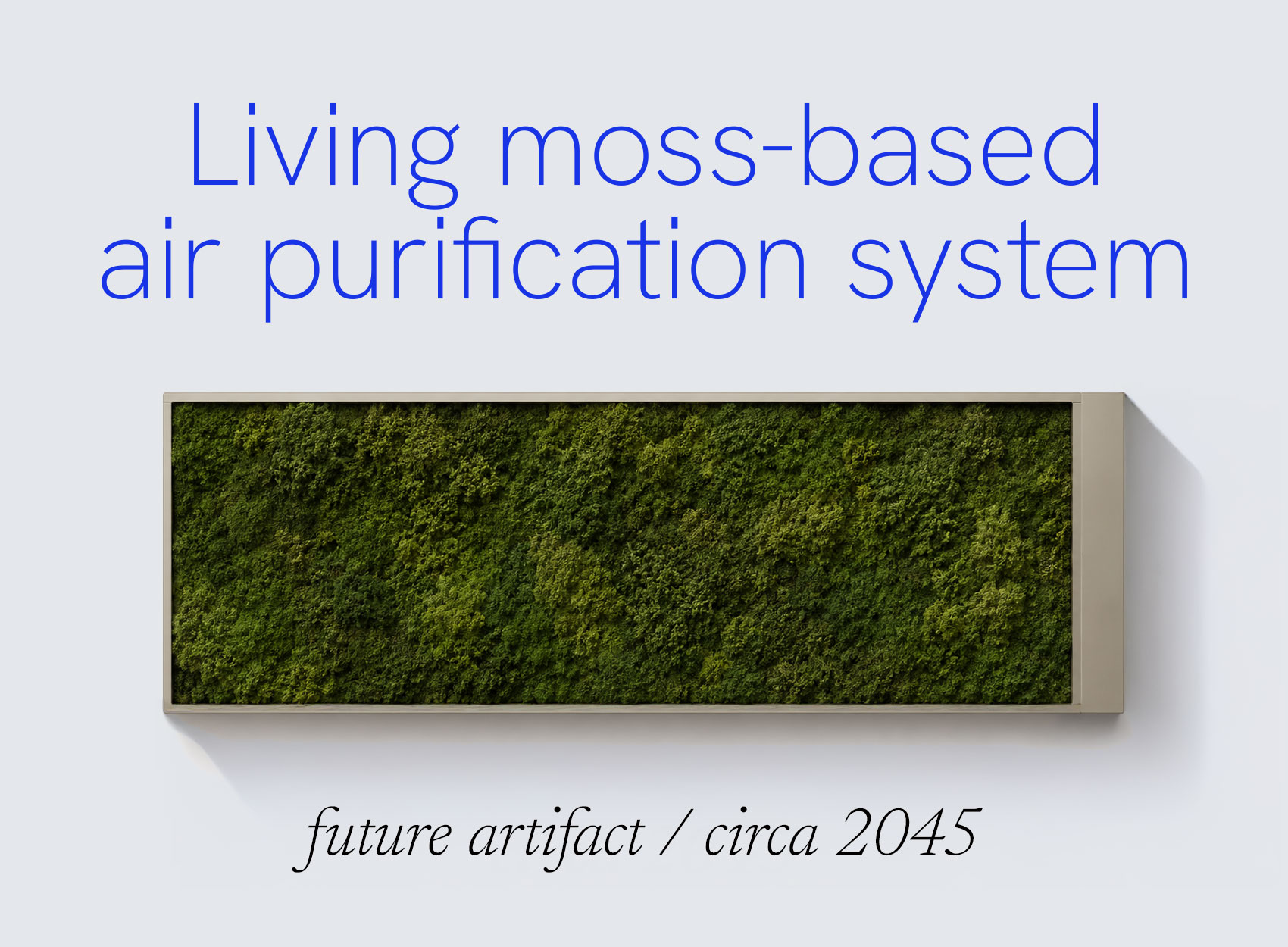
Future Artifacts

Signals from the edge

When the building starts breathing

Published June 23, 2026

Living air systems use biological material — plants, mosses, algae, microbes or growth media — as part of how a building senses, filters or signals environmental health. Buildings are beginning to bring biology into their air-quality systems: moss panels in cities, engineered plant-microbe products in the consumer market and active green walls in offices, lobbies and care-adjacent spaces. None is the whole future. Some are overclaimed. Together, they raise the real foresight question: what would have to become true before living air systems deserve a place in future facilities strategy?

Moss as urban air-cleaning infrastructure

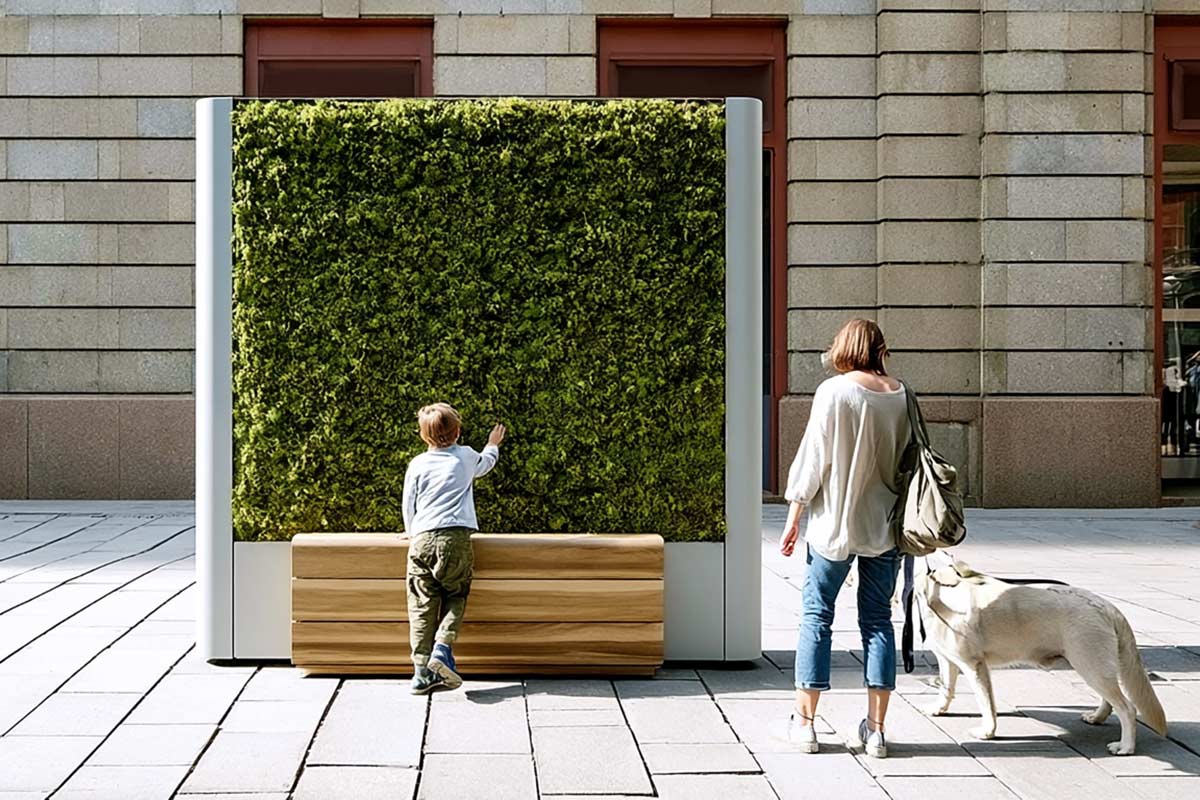
Sensor-and-fan moss panels — including Green City Solutions’ CityTree — are already being tested as urban air-quality infrastructure. In Modena, an active unit reduced PM2.5 by 15–20% and ultrafine particle number concentration by 38%.12 This is a real outdoor signal, not proof that moss can clean a hospital room.

Moss panel installation in an urban setting
Image · moss panel

Active green walls move beyond decor

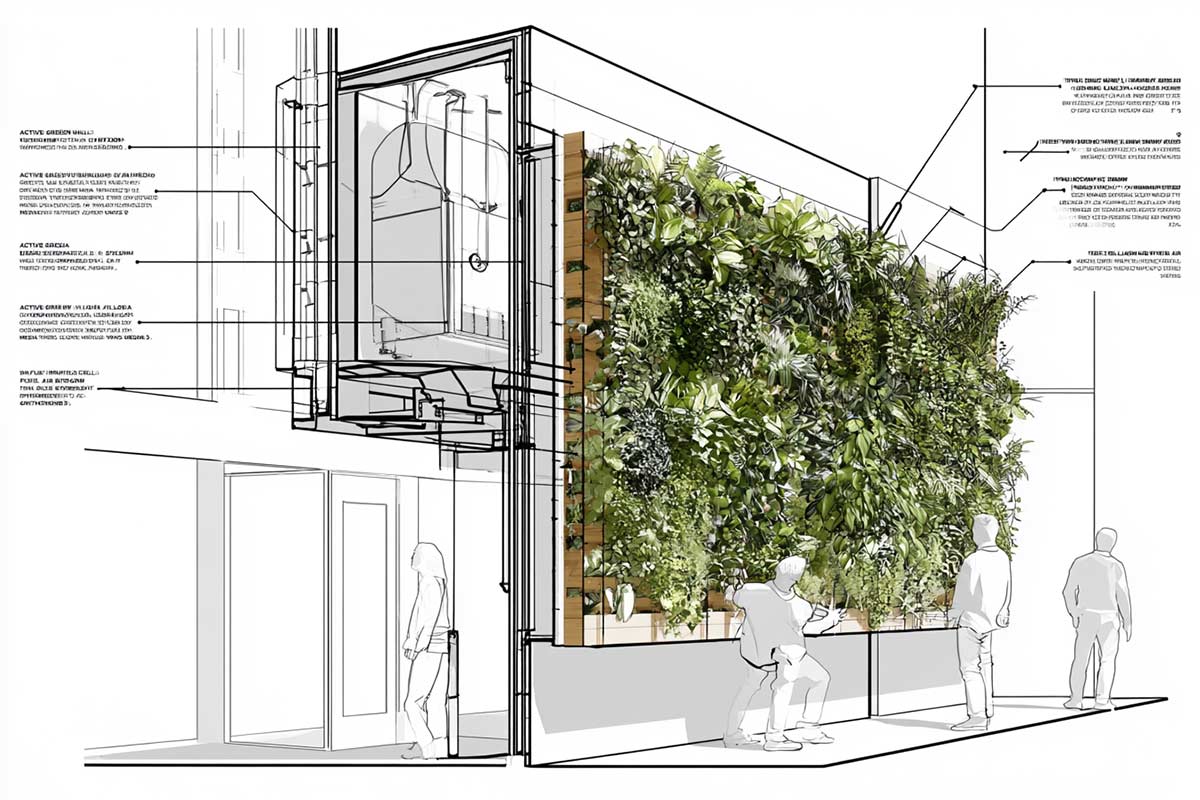
The important shift is from decorative greenery to performance-seeking systems. Active green walls mechanically draw air through roots, growth media or biologically active zones, which is what makes pollutant reduction more plausible.3 Airflow is the difference between decor and infrastructure.

Active green wall drawing air through living media
Image · active green wall

Engineered plant-microbe products enter the air-quality market

The frontier is not the ordinary houseplant. It is the maintained microbiome. Neoplants’ Neo Px pairs a plant with microbial support marketed to target benzene, toluene and xylene.4 It is a genuine market signal, not yet independently validated as a room-scale purifier.5 The strategic question is whether managed biology can become reliable enough for buildings to operate.

Houseplant with an engineered root microbiome
Image · plant-microbe

Public prototypes test living air

In Warsaw, ecoLogicStudio’s AirBubble playground used algae bioreactors, sensors and an ETFE enclosure to create a monitored clean-air microclimate for children. It is not independent proof that living air systems are ready for healthcare. It is a useful design signal: biological air infrastructure is moving into public environments where performance claims, experience and trust can be tested together.

AirBubble bioreactive playground in Warsaw
Image · AirBubble, Warsaw

Signal vs. noise

The signal is not that plants clean buildings by themselves. The signal is that biological systems are being paired with airflow, sensors, microbes, service models and public demonstrations. Those claims sound similar, but they deserve very different levels of trust.

Signal

Airflow is the first credibility test

Living systems become more plausible when air is actively moved through roots, growth media, moss, algae or another biologically active zone. If a vendor cannot explain how air reaches the biology, treat the performance claim with suspicion.

Signal

Infrastructure that has to be kept alive

The real pattern isn’t “plants.” It’s living matter combined with sensors, service models and continuous care. The edge signal is infrastructure whose performance depends on biological health, not only mechanical function.

Signal

Plant-microbe partnerships expand the design space

Engineered or managed microbiomes may expand what plant-based systems can do. They also demand more operational discipline, not less: re-dosing, monitoring, quality control and oversight that inert equipment never needed.

Signal

Biophilic value is real, but different

Biophilic design isn’t the new signal here. It’s established context.7 The edge is that living air systems may bundle air-quality claims, wellbeing value6, sustainability and trust into one proposition. That value may matter, especially in healthcare, but it shouldn’t be used as a substitute for filtration evidence.

Noise

Passive plants as air purifiers

A few potted plants will not clean a building’s air at any meaningful scale; the ventilation math isn’t close.8 A poorly designed passive wall can even resuspend particles it should trap.9 Passive greenery may support experience, but it shouldn’t be filed under filtration.

Noise

“Green equals safe”

A system can look healthy and still be clinically unsafe. In a care setting, a living biofilter that isn’t rigorously controlled is a potential contamination source, not a guaranteed benefit.10 Green is not a clearance.

What would make this real

As of June 2026

Living air systems already exist in partial form: outdoor moss panels, active green walls, engineered plant-microbe products and public prototypes. The question is what would have to change before leaders should treat them as serious facilities strategy rather than experience design, sustainability storytelling or early-stage experimentation.

WatchpointWhat would change the decisionCurrent status
Room-scale performanceA living system meets stated particulate or VOC targets in a third-party, full-room study under realistic ventilation, occupancy and maintenance conditions — not only a chamber, lab or single-pass test.EmergingActive systems show promise; real-room evidence remains uneven.
Public-space validationA biologically active air system demonstrates durable, monitored performance in a real public environment across weather, occupancy, seasons and maintenance cycles.EmergingPublic demonstrations exist; independent long-term validation is limited.
Stable managed microbiomesPlant-microbe systems show durable pollutant-reduction performance without frequent re-dosing, instability or company-only validation.EmergingCommercial products exist; independent room-scale evidence is limited.
Operating-model maturityProcurement, maintenance, monitoring, inspection and liability models exist for living infrastructure delivered as a service.EarlyThe service model is visible, not yet mature for healthcare.
Durable indoor mossIndependent evidence shows indoor moss systems surviving 12 months or longer under real building conditions, without unacceptable fungal growth, dieback or maintenance burden.11Not yetViability remains a constraint.
Healthcare relevanceA peer-reviewed clinical study shows a living biofilter meeting an infection-control-relevant threshold in a real care setting.Not yetThe decisive healthcare threshold.

How to build readiness

1Treat this as an operating-model signal

The bigger shift is not a better filter. It’s the possibility that facilities teams may one day manage living systems whose performance depends on airflow, humidity, light, microbial balance and maintenance discipline. That’s the capability worth building toward, whatever happens to moss specifically.

2Pilot where learning is safe

Don’t start in patient rooms. Start in lobbies, offices and waiting areas — lower-risk spaces where the organization can learn the reality of keeping a living system alive before anything is asked to protect a vulnerable patient.

3Keep the value streams separate

Most disappointment will come from collapsing distinct kinds of value into one promise. Judge each value stream on its own evidence:

  • Biophilic valueDoes it make the space feel better?
  • Experience valueDoes it change how people perceive the environment?
  • Sustainability valueDoes it reduce waste or support regenerative design goals?
  • Air-quality valueDoes it measurably reduce pollutants?
  • Clinical valueDoes it meet safety thresholds for care environments?

4Build governance before scale

If living infrastructure matures, organizations will need policies before they need more installations — for maintenance, monitoring, inspection and liability. The governance is the unglamorous part that decides whether this is ever safe to scale.
The futurist’s take

The opportunity is real.
The hype is real too.

The signal is not that moss is about to replace mechanical filtration. It is that buildings are being asked to do more: sense more, adapt more, support people better and carry more visible evidence of environmental care.

The organizations that take this seriously will not buy the greenest-looking wall. They will know how to test, govern and maintain infrastructure that is no longer inert.

From evidence to artifact

See how we used disciplined imagination to turn weak signals into a tangible artifact from the future.

References

  1. Donateo et al. (2021). An evaluation of the performance of a green panel in improving air quality (CityTree, Modena, Italy). doi:10.1016/j.atmosenv.2021.118189
  2. Kārkliņa et al. (2025). Atmospheric pollution particulate matter absorption efficiency by bryophytes in laboratory conditions. doi:10.3390/atmos16040479
  3. Pettit, Irga and Torpy (2019). The in situ pilot-scale phytoremediation of airborne VOCs and particulate matter with an active green wall. doi:10.1007/s11869-018-0628-7
  4. Li et al. (2023). Reduction and control of air pollution: based on plant-microbe interactions. doi:10.1080/26395940.2023.2173657
  5. Simmer and Schnoor (2022). Phytoremediation, bioaugmentation, and the plant microbiome. doi:10.1021/acs.est.2c05970
  6. Cedeño Laurent et al. (2021). Associations between acute exposures to PM2.5 and carbon dioxide indoors and cognitive function in office workers. doi:10.1088/1748-9326/ac1bd8
  7. Zhong, Schröder and Bekkering (2021). Biophilic design in architecture and its contributions to health, well-being, and sustainability. doi:10.1016/j.foar.2021.07.006
  8. Cummings and Waring (2020). Potted plants do not improve indoor air quality. doi:10.1038/s41370-019-0175-9
  9. Ysebaert et al. (2024). Assessing particulate matter deposition and resuspension by living wall systems in a wind tunnel setup. doi:10.3390/su162310733
  10. Moslehian et al. (2023). Potential risks and beneficial impacts of using indoor plants in the biophilic design of healthcare facilities. doi:10.1016/j.buildenv.2023.110057
  11. Zechmeister et al. (2023). Viability of living moss for indoor green walls. doi:10.3390/su152115625
Additional references
  1. Bandehali et al. (2021). Current state of indoor air phytoremediation using potted plants and green walls. doi:10.3390/atmos12040473
  2. Chaudhuri and Roy (2023). Global ambient air quality monitoring: can mosses help? doi:10.1007/s10668-023-03043-0
  3. González-Martín et al. (2021). A state-of-the-art review on indoor air pollution and strategies for indoor air pollution control. doi:10.1016/j.chemosphere.2020.128376
  4. Kumar et al. (2023). A systematic review on mitigation of common indoor air pollutants using plant-based methods. doi:10.1007/s11869-023-01326-z
  5. Maurya et al. (2023). Microbially-assisted phytoremediation toward air pollutants. doi:10.1016/j.eti.2023.103140
  6. Pettit, Irga and Torpy (2018). Towards practical indoor air phytoremediation: a review. doi:10.1016/j.chemosphere.2018.06.048
  7. Wang et al. (2021). How indoor environmental quality affects occupants’ cognitive functions. doi:10.1016/j.buildenv.2021.107647

The next hard question is coming.

Let’s make sure you have somewhere to take it.

Start a conversation