Work
Service design + operational coordination

Designing smoother arrival experiences for high-stress moments.

How a large institution rethought frontline roles, spatial flow and staffing systems to reduce friction and build trust during one of its highest-stress transition moments.

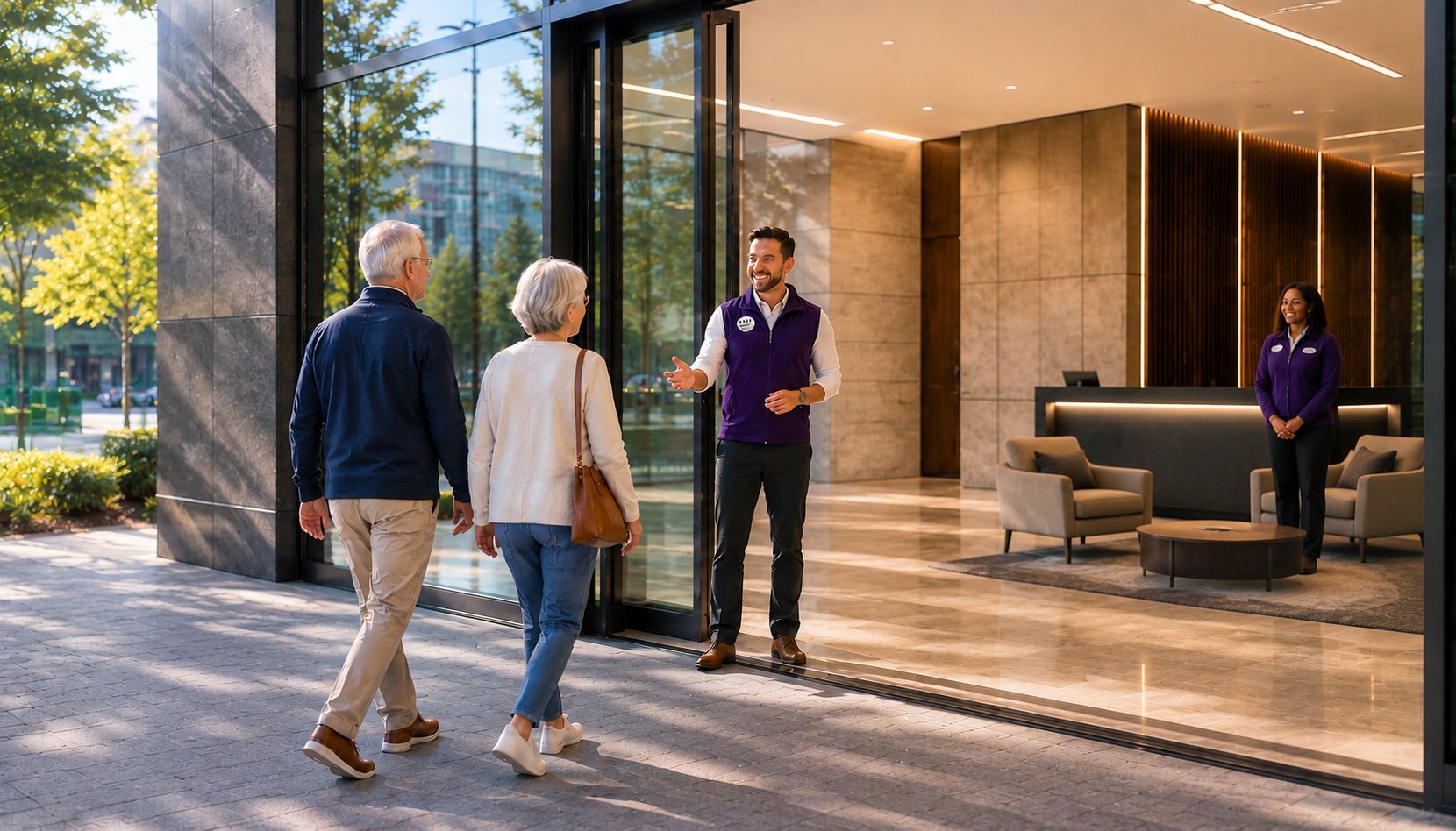
Editorial photograph — an older couple is directed into a sunlit institutional entry by a frontline staff member in a purple vest; a second team member stands ready near a quiet seating area inside.

Arrival is one of the highest-friction transition moments in any complex institution.

We partnered with a large institution to rethink how people move through the first moments of entering a complex operational environment.

As access and security protocols expanded across many sectors, arrival environments became increasingly transactional and operationally rigid — fragmenting the clarity, reassurance and orientation people needed most during high-stress transitions.

The effort examined how staffing systems, frontline roles and spatial design could work together to reduce friction and build institutional trust at the point of arrival.

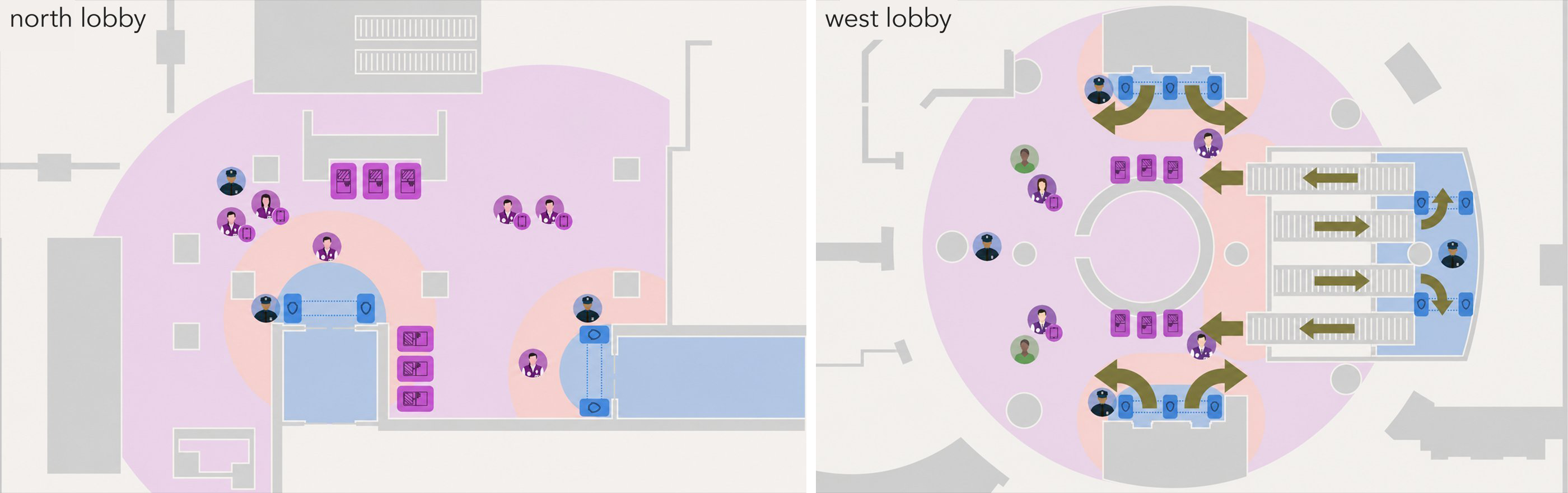
Three arrival zones Zone 1 Security Zone 2 Orient and direct Zone 3 Guide and assist

How can arrival systems be coordinated to reduce uncertainty, support transition and build institutional trust?

The situation

Many institutional arrival systems were optimized for control rather than coordination.

Arrival systems often evolved through layered decisions made independently across security, facilities, visitor access and operations — producing fragmented environments that created confusion, cognitive overload and unclear frontline responsibilities.

COVID-era restrictions intensified these dynamics, pushing arrival further toward enforcement, routing and throughput.

The challenge extended well beyond facilities or front-desk reform. The institution needed to rethink how staffing systems, workforce identity and behavioral signaling worked together as a single integrated architecture.
Pressures shaping arrival coordination
  • Transactional arrival flow
  • Fragmented operational ownership
  • Frontline role ambiguity
  • Inconsistent navigation and guidance
  • Security-heavy environments
  • Workforce burnout and behavioral inconsistency
Plan-view comparison of two arrival coordination zones — each rendered with three nested layers (security at the threshold, orient-and-direct around it, guide-and-assist enveloping both) populated with frontline figures at their stations and flow arrows tracing movement through the system.
What we are exploring

Designing arrival as institutional choreography.

The effort examined how frontline roles, environmental signals, behavioral expectations and service design could work together to create clearer, more navigable arrival flow.

Arrival was reframed as a coordinated system — spanning people, processes, behaviors and spatial logic — not a collection of isolated operational tasks.

The work also examined how workforce identity, peer learning and operational visibility could help sustain long-term behavioral change.

A frontline staff member in a purple vest steadies an older visitor as she steps from a car, a wheelchair positioned beside her on a sunlit urban streetscape with trees, brick paving and city buildings beyond.
Areas explored
  • Frontline workforce identity and role clarity
  • Operational sequencing across frontline roles
  • Zone-based navigation and behavioral signaling
  • Workflow mapping across roles and functions
  • Environmental signaling and behavioral reassurance
  • Alignment between guidance, access and security
Design posture

Operational systems quietly communicate what institutions value.

As institutions automate and operationalize more of the visitor journey, the moments of human reassurance that remain carry disproportionate institutional weight.

The goal was not improving efficiency or standardizing workflows — but designing systems that help people feel oriented, supported and grounded during moments of uncertainty.

Manager Supervisor Lobby Coordinator Roaming Coordinator Security Officer Transport Main entry tasks Greeting Guidance & navigation Issuing passes Transporting visitors Mobility assistance Communication Senior staff entry tasks Training Complicated questions Deescalation Managing entry floor Service recovery Leads huddles Oversight & management Receiving reports Coord. departments Evaluations Scheduling, balancing PTO & absences
What this work is shaping

Building trust infrastructure into institutional transitions.

The work helped leadership teams move beyond thinking about arrival as a facilities function — toward a broader understanding of how coordinated systems shape behavioral and institutional trust.

Rather than separating access, guidance, security, navigation and workforce operations into disconnected functions, these systems could operate as a unified architecture.

The resulting model demonstrated how institutions can build greater trust, clarity and behavioral reassurance through the intentional alignment of frontline systems.

How the work shapes institutional alignment
  • Frontline roles gain operational clarity
  • Institutional systems support behavioral reassurance
  • Environments become more navigable and legible
  • Guidance, access and security operate as a coordinated system
  • Institutions operationalize trust through systems design
  • Human interaction becomes more intentional and operationally meaningful

The future of institutional arrival may depend less on automating human interaction and more on coordinating the moments that build trust.

Start a conversation ↗