A foresight and systems strategy engagement helping a major payer-provider understand how AI, trust, financing and consumer agency may reshape the member relationship over the next decade.
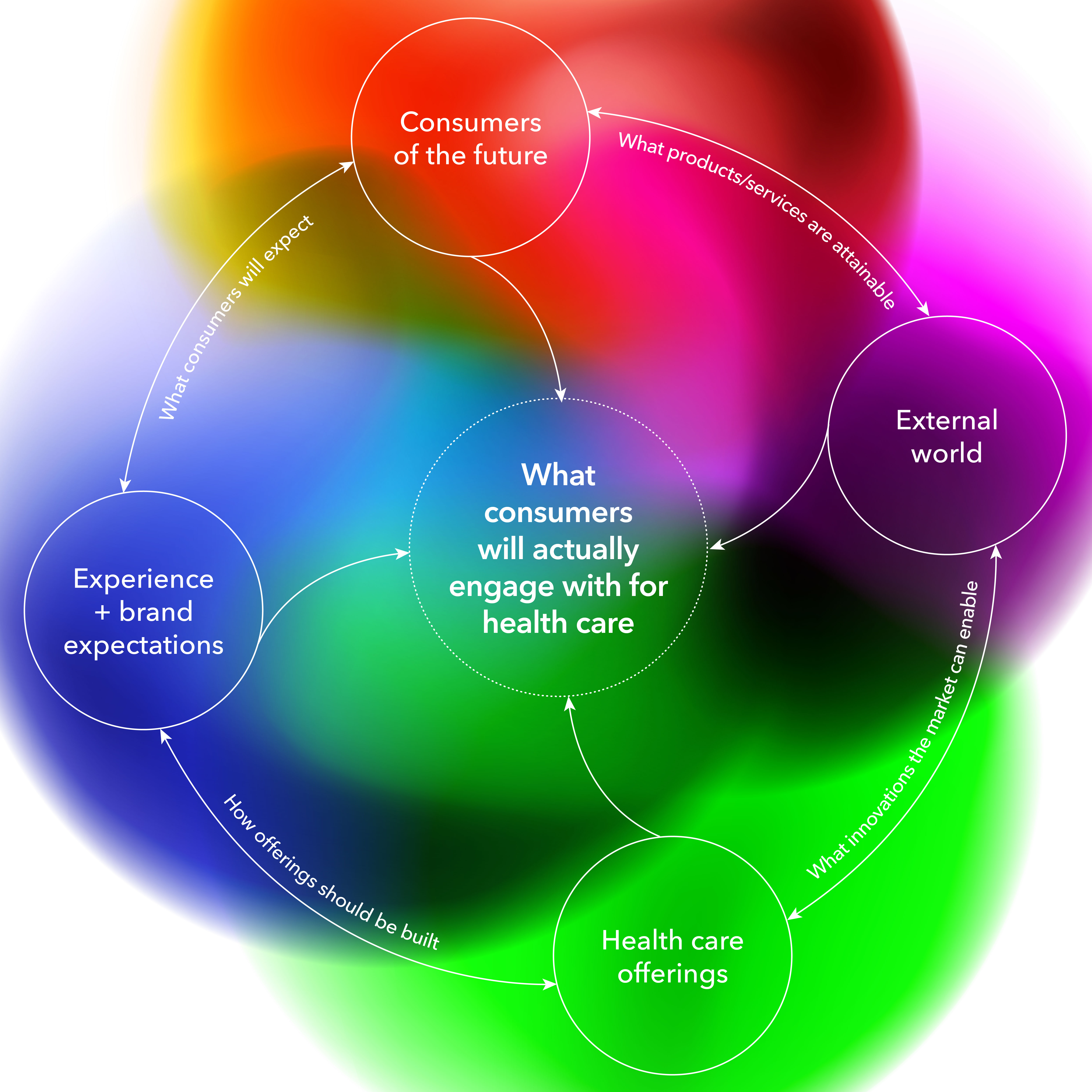
We helped one of the nation’s largest payer-provider systems examine a strategic risk hiding in plain sight: the healthcare consumer its model was built around is disappearing.
The future member is more informed, more agentic and less likely to accept institutional authority by default.
They can use AI as a first stop, assemble care outside the system, manage their own health data, question the financial logic of insurance and withdraw trust when the system’s interests feel misaligned.
What happens when the consumer your model was built around no longer defaults to the system?
The integrated care model depends on a set of assumptions: that members will stay, share their data, defer to clinical authority, use primary care as the front door and treat the health plan relationship as a default.
Each once felt durable. Together they are becoming less reliable — as members gain more tools, more choices and more reasons to question whether the system’s interests align with their own.
AI, direct-pay care, consumer health platforms and modular health ecosystems are changing the front door to care. And whoever owns the first interaction increasingly owns the relationship, the data and the routing decision.
The project explored what happens when those assumptions no longer hold — and where the member relationship could erode before it becomes visible in the market.

Using foresight as the method, the work built five divergent futures for the healthcare consumer and for the integrated primary care and insurance model.
Across those futures, we developed future consumer profiles — showing how the same person might behave very differently depending on how trust, financing and access are organized.
From there, it synthesized cross-scenario implications for primary care relevance, the insurance relationship, member loyalty and organizational strategy.
The through-line across every scenario was the same: in a more fragmented market, integrated systems can no longer assume loyalty. They have to earn it.
So the work focused less on predicting one future and more on building the judgment to act across several — to see where the member relationship could erode, and where integration could become a genuine advantage.
The opportunity it kept pointing to: becoming the trusted integrator of a more fragmented health ecosystem — the one that helps members navigate complexity rather than simply controlling access.
The work gave leadership a clear-eyed view of where the future member relationship is most exposed — and where the integrated model could become more valuable, not less.
Rather than a single forecast, it produced a set of strategic signals leaders can act on now — before they surface in the market.
The throughline: trust is becoming one of the most strategically valuable assets in healthcare, and integration is worth most when it helps people navigate complexity rather than control access.
This work helped leaders see where the member relationship could erode before it becomes visible in the market — and where the integrated model could become more valuable, not less, in a future defined by fragmentation, autonomy and conditional trust.
Start a conversation ↗