Work
Leadership systems + continuous transformation

Building leadership systems for continuous transformation.

Examining what executive leadership and institutional coordination need to become inside organizations operating under continuous adaptation.

Editorial four-panel composition — leaders captured in moments of attention, reflection and dialogue, softly diffused through glass.

Organizations are no longer transitioning occasionally.

A large, complex organization engaged us to explore how leadership systems may evolve as institutions increasingly operate under conditions of continuous technological, operational and cultural change.

The work explored how leadership models designed for more stable environments can grow into operating systems capable of coordinating distributed decision-making, evolving roles and embedded technologies.

Rather than treating transformation as a temporary disruption to manage, the effort explored what happens when continuous adaptation becomes part of the operating environment itself.

Advocate Human Champion Anticipator Change Catalyst Attractor Influence Cultivator Arranger System Orchestrator Assembler Network Weaver Aligner Ethical Integrator

How do leaders learn to adapt continuously without losing trust, coordination or clarity?

The situation

Most leadership systems were built for a slower era.

Organizations now face mounting pressure from accelerating technological change, workforce disruption and growing operational complexity. At the same time, new technologies are becoming increasingly embedded inside decision environments, governance structures and everyday work.

The challenge extends beyond technology adoption alone. Organizations must also rethink how trust, leadership and coordination function under continuously shifting conditions.

Pressures shaping organizational adaptation
  • Accelerating technological change
  • Workforce disruption and fatigue
  • Distributed decision-making
  • Governance ambiguity
  • Increasing operational complexity
  • Persistent transformation pressure
  • Declining institutional trust
  • Embedded operational technologies
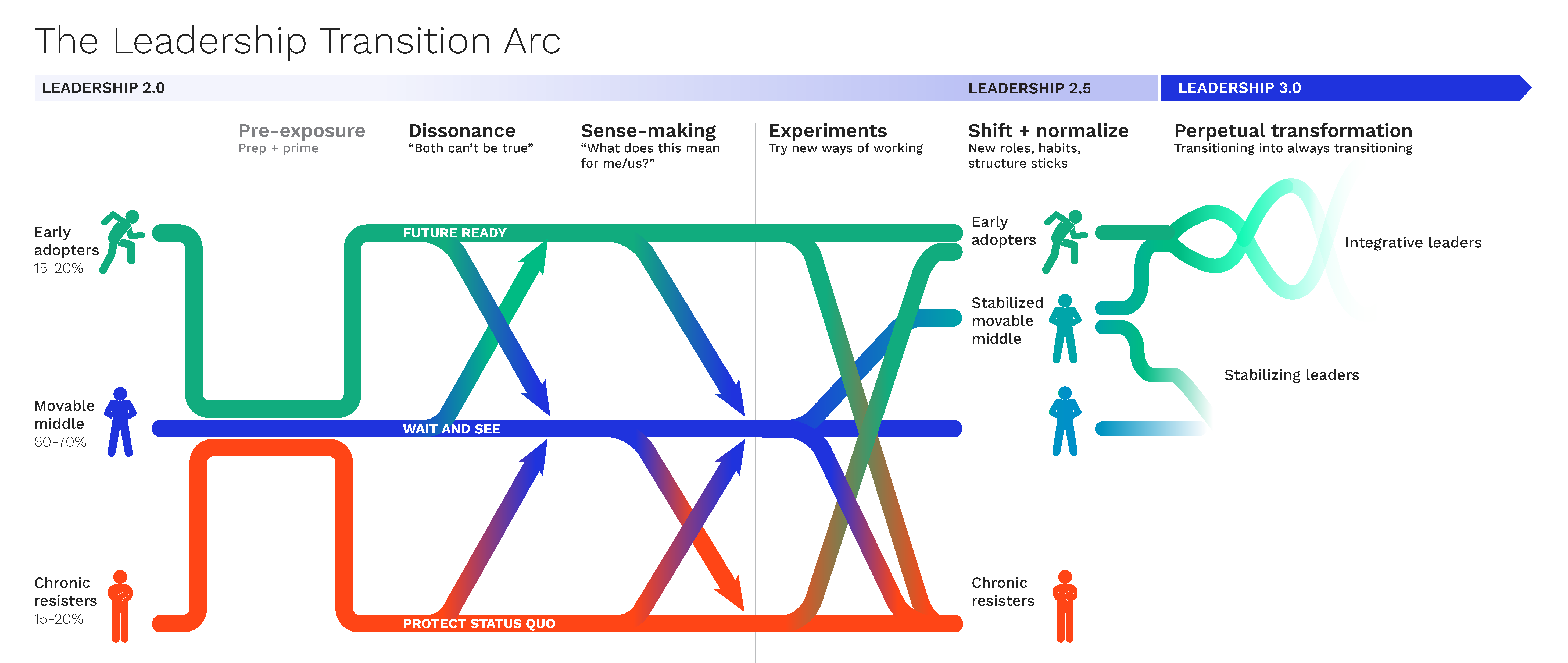
The Leadership Transition Arc: early adopters (15–20%) move from Future Ready through Tactically Compliant into Integrative leaders; the movable middle (60–70%) move from Wait and See into a Stabilized movable middle; chronic resisters (15–20%) move from Protect Status Quo toward attrition. The arc spans Pre-exposure, Dissonance, Sense-making, Experiments, Shift + normalize and Perpetual transformation.
What we are exploring

Adaptation without organizational fracture.

The effort approached transformation as a broader organizational systems challenge rather than a traditional change initiative. A central insight emerged early: organizations do not experience disruption uniformly.

Different teams, leaders and workforce groups respond to uncertainty and operational change from very different emotional and organizational starting points. The work explored how leadership systems may support continuous adaptation while preserving trust and strategic alignment.

A leader stands in soft diffused light, hands raised in animated thought — the moment of sense-making during continuous change.
Areas explored
  • Leadership operating models for evolving organizations
  • Distributed decision-making structures
  • Adaptive governance under continuous change
  • Organizational resilience across operational complexity
  • Institutional coordination across rates of change
  • Trust conditions during continuous transformation
  • Ethical decision-making within complex operating environments
  • Leadership readiness across uneven adoption
  • Cultural conditions that accelerate or inhibit adaptation
Strategic posture

Continuous adaptation requires calmer systems, not louder ones.

The goal is not creating organizations that constantly feel disrupted. The goal is building systems capable of absorbing change without destabilizing the people inside them.

The strongest adaptive organizations often feel the most operationally steady.

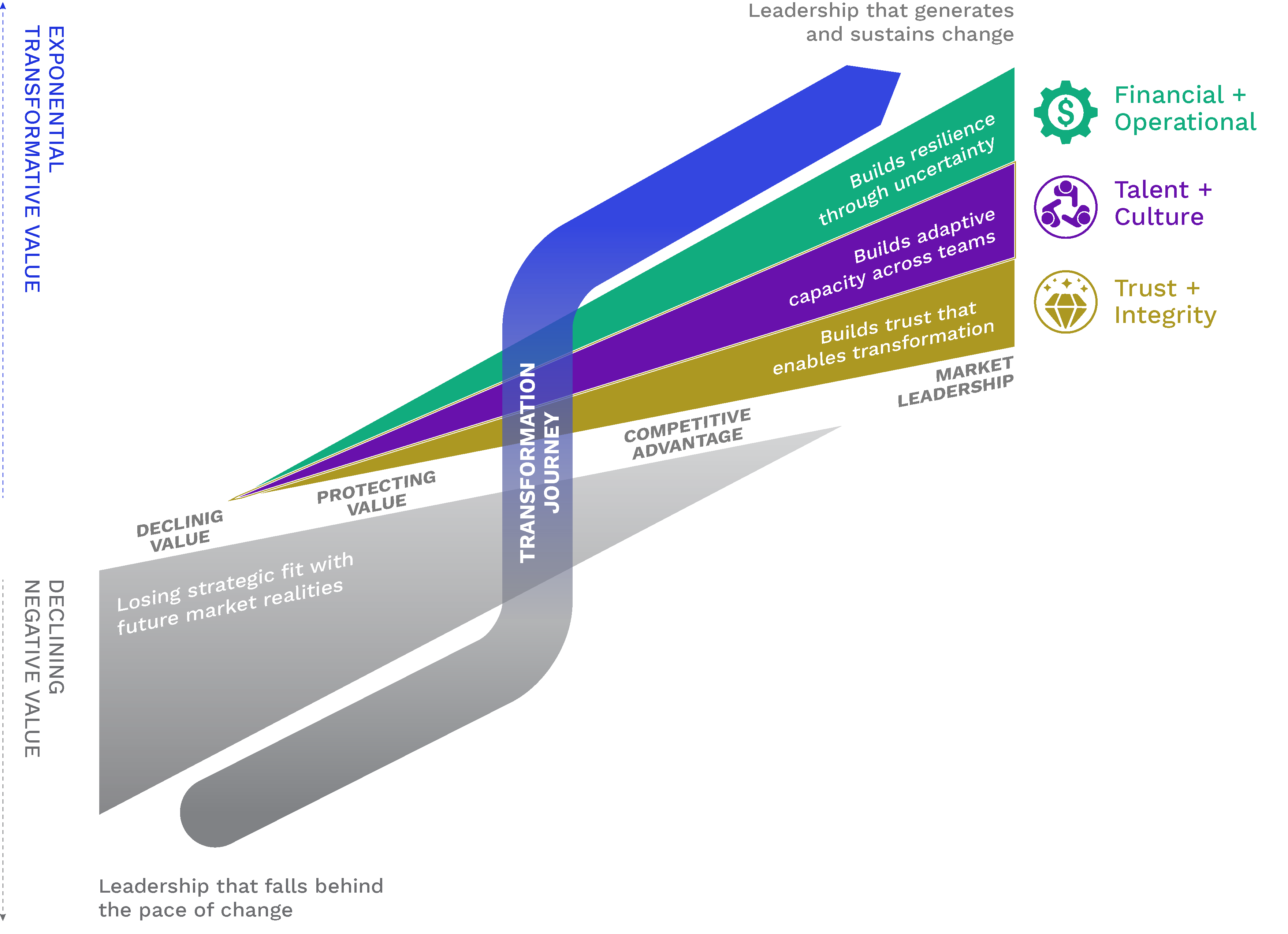
Two diverging trajectories rising and falling from a shared transformation journey: the upward path builds resilience through uncertainty, adaptive capacity across teams and trust that enables transformation, reaching market leadership; the downward path loses strategic fit with future market realities.
What this work is shaping

Beyond transformation programs.

The work helped leadership teams explore how their organization can evolve as technologies, roles and coordination structures become increasingly interdependent across everyday operations.

Rather than treating transformation as a temporary initiative, the effort reframed it as an ongoing leadership capability.

How the work shapes future organizations
  • Leadership becomes more distributed
  • Executive systems become more adaptive
  • Governance evolves alongside changing operating conditions
  • Human judgment remains central
  • Organizations respond more dynamically to change
  • Institutional systems support continuous learning
  • Trust becomes a strategic capability
  • Leadership capability becomes operationalized

The organizations best positioned for the next era may not be the ones changing the fastest, but the ones capable of evolving continuously without losing trust, coordination or clarity.

Start a conversation ↗